How to sell my HVAC business
How To Sell My HVAC BusinessThe 6-Step Roadmap (2026)
A practical, citation-backed guide for HVAC owners thinking about an exit in the next 12–36 months. Real BizBuySell sale prices, current EBITDA multiples, the 6-month sale cycle, and the seven value drivers that decide your final number.
What HVAC businesses actually sell for
Independent benchmarks from BizBuySell, First Page Sage, and the U.S. Bureau of Labor Statistics — the numbers buyers and their QofE teams underwrite to.
The 6-step roadmap, at a glance
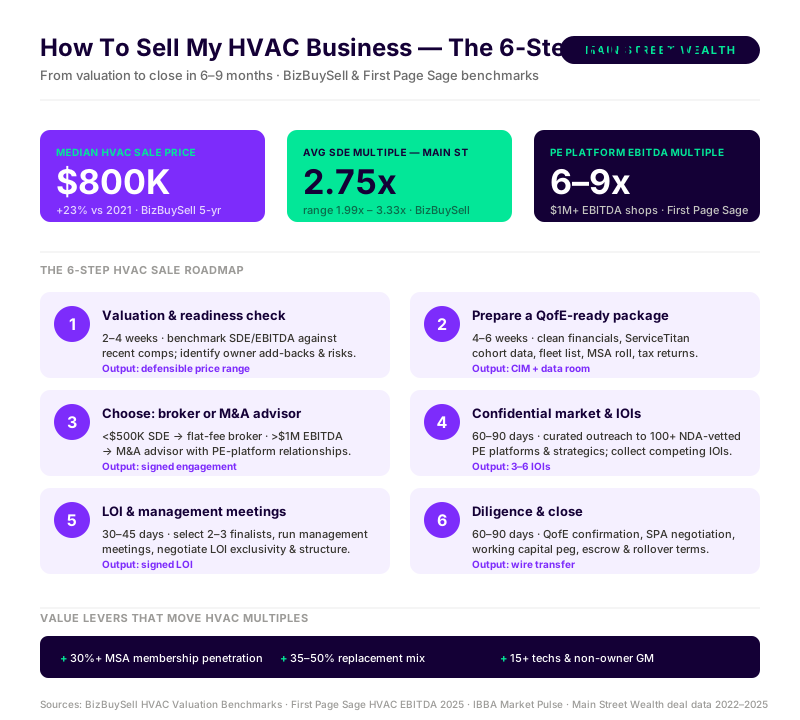
How to sell an HVAC business — visual roadmap
Why HVAC owners are selling now
HVAC services is one of the most consolidated home-services categories in private equity. Major roll-ups — Wrench Group, Sila Services, Apex Service Partners, Service Champions — have been acquiring residential HVAC businesses since 2018, paying premium multiples for companies with strong recurring service revenue, technician retention, and clean books. PE’s share of HVAC transactions nearly tripled in a single recent year.
According to IBISWorld, the U.S. HVAC services industry generates more than $140B in annual revenue, with steady mid-single-digit growth tied to housing starts, replacement cycles, and the electrification of heating loads. The U.S. Bureau of Labor Statistics projects roughly 6% employment growth for HVAC mechanics through 2032 — faster than the average occupation — and continues to flag a structural technician shortage that is rewarding well-run operators.
For founder-owners considering a sale, that combination of demand, capital availability, and technician scarcity is the cleanest tailwind we have seen in a decade. The decision now isn’t can I find a buyer — it’s which buyer, what structure, and what process maximizes my net proceeds.
Step-by-step
The 6-step HVAC sale roadmap
From a defensible valuation to wire transfer in 6–9 months. Skip any step and you usually pay for it in retrades or timeline.
Get a defensible valuation first
2–4 weeksBuild a quality-of-earnings (QofE) ready package
4–6 weeksChoose: business broker or M&A advisor
1–2 weeksConfidentially market and collect IOIs
60–90 daysNegotiate LOI and management meetings
30–45 daysConfirmatory diligence and close
60–90 daysThe 7 value drivers that decide your HVAC sale price
Buyers underwrite to a model. These are the inputs that move price most — fixed in order of impact for HVAC service-led businesses.
| Driver | Healthy range | Why it matters |
|---|---|---|
| Adjusted EBITDA | $1M – $5M+ | PE platforms typically underwrite from $1M EBITDA up; sub-$750K shops trade 3x–5x as Main Street. |
| Service-plan / membership revenue | 25–35%+ of revenue | The single biggest multiple driver. Buyers pay for renewable, contracted revenue. |
| Replacement vs. repair mix | 35–50% replacement | A healthy replacement contribution signals demand-pull and a maturing customer base. |
| Customer concentration | <10% any single customer | Concentrated commercial accounts are the #1 source of LOI retrades in diligence. |
| Owner dependence | Non-owner GM + dispatch lead | Buyers pay premium multiples when day-to-day operations don't require the seller. |
| Technician headcount | 15+ field technicians | Scale and bench depth materially de-risk PE underwriting. |
| Trailing-twelve-month revenue | $3M – $30M+ | Most lower middle-market HVAC deals close between $5M and $30M in revenue. |
Keep going
Deeper resources for HVAC owners preparing for a sale.
How to sell my HVAC business — frequently asked questions
Practical, data-backed answers for HVAC owners considering a sale.
Confidential 60-minute strategy session
We’ll review your latest financials, place your business on the market spectrum, and lay out a realistic path to close. No obligation.
Loading calendar...
Ready to find out what your HVAC business is really worth?
Free valuation, confidential process, and a fee structure tied to your closing price.
Confidential · No obligation · Top 25 Lower Middle-Market Firm (Axial 2025)